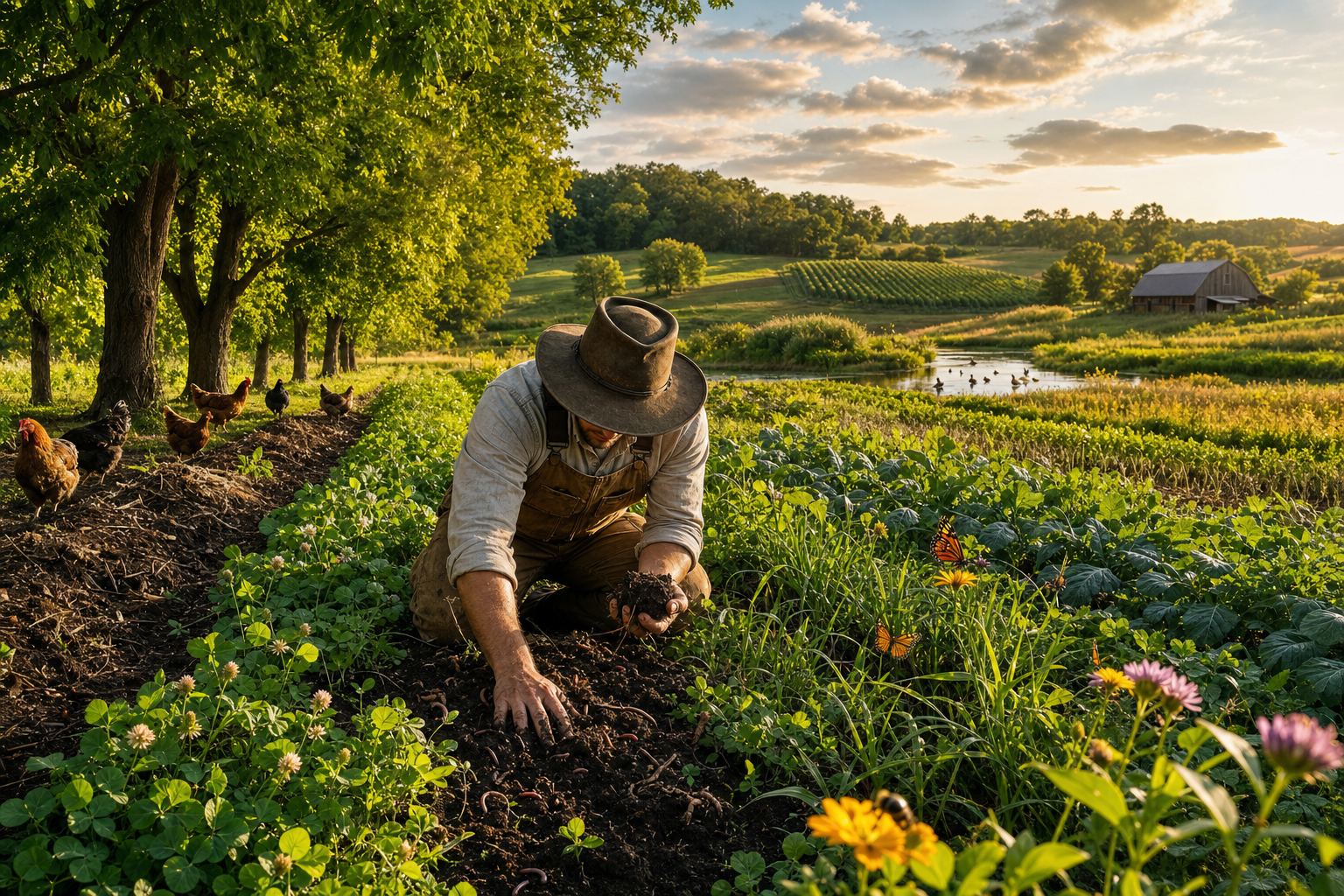
Regenerative Farming
Industrial farming mines the soil one tillage pass at a time. Regenerative farming rebuilds it — trading chemical dependency for biological resilience, lower long-term input costs, and a crop residue that may soon be worth more as jet fuel than as mulch.
Published June 23, 2026·Last revised June 23, 2026
Beneath every field of industrial corn is a soil biology catastrophe in slow motion. Decades of tillage and synthetic chemistry have reduced much of America’s most productive farmland to a mineral substrate kept alive only by annual injections of nitrogen, phosphorus, and potassium. Regenerative farming is the project of putting life back into that substrate — not as an ideological statement, but as an agronomic and eventually economic necessity.
What It Is
Regenerative agriculture is a set of practices designed to restore and improve the biological systems underneath food production: soil microbial communities, fungal networks, water infiltration, and carbon storage. Unlike conventional sustainability — which aims to slow degradation — regenerative systems aim for net restoration. A farm transitioning to regenerative practices measures its success in soil organic carbon gained per year, not just inputs avoided.
The term draws from several traditions: the Rodale Institute’s organic farming research dating to the 1940s, Allan Savory’s holistic planned grazing developed in the 1980s, and the USDA Natural Resources Conservation Service’s soil health movement, which formalized five guiding principles in the 2010s. What unites them is the observation that healthy soil is a living system, not a growth medium, and that industrial agriculture has been liquidating it.
How It Works
The USDA NRCS codifies regenerative practice around five soil health principles (USDA NRCS Soil Health):
- Minimize soil disturbance — no-till or strip-till to protect fungal networks and soil structure
- Maintain continuous soil cover — cover crops or crop residue left on the surface to prevent erosion and UV-driven biological die-off
- Maintain living roots year-round — roots continuously feed soil biology through root exudates; bare off-season fields are biologically inert
- Maximize diversity — diverse crop rotations, cover crop mixes, and perennial integration over monocultures
- Integrate livestock — managed grazing animals that cycle nutrients and stimulate plant regrowth
| Dimension | Industrial / Conventional | Regenerative |
|---|---|---|
| Tillage | Annual moldboard or disc plowing; exposes soil carbon to oxidation every year | No-till or narrow strip-till; soil structure intact season over season |
| Nitrogen | Synthetic N-P-K at or above agronomic rate; 40–60% leaches to groundwater and streams | Legume cover crops fix atmospheric N; biological inoculants supplement; targeted synthetic as needed |
| Carbon balance | Net exporter — tillage oxidizes soil organic carbon annually | Net importer — root biomass and reduced disturbance build soil organic carbon year over year |
| Water infiltration | Compacted, crusted soils shed rainfall; high runoff, high irrigation need | Porous soil structure absorbs rainfall; drought-resilient; reduced irrigation |
| Yield trajectory | High in year 1; stagnant or declining without input escalation | Lower in years 1–2 of transition; stable or improving after 5–10 years |
| Input dependency | High and increasing — fertilizer, seed, pesticide, fuel | Declining over time as soil biology rebuilds; break-even on input costs typically within 3–5 years |
Sources: USDA NRCS Soil Health; Meena et al., Nature Scientific Reports, 2025
A 2025 meta-analysis of 147 peer-reviewed studies confirmed regenerative practices produce a mean 17% gain in soil organic carbon (SOC) over baseline levels — the clearest quantitative evidence available that the biological restoration actually happens (Meena et al., Nature Scientific Reports, 2025).
The Transition Challenge
The hardest part of regenerative farming is not agronomic knowledge — it is financial survival during the transition. Soil biology takes years to rebuild. Yields dip before they recover. Management complexity goes up before it comes down. The farmer absorbs all of this risk alone.
| Phase | Timeline | Economics vs. Conventional | Primary Challenge |
|---|---|---|---|
| Transition | Years 1–3 | ~$40/acre average profitability loss vs. conventional baseline | Yield gaps while soil biology rebuilds; new management practices unfamiliar; lenders skeptical |
| Stabilization | Years 3–5 | Approaching parity; some studies show statistical equivalence by year 3 as lower input costs offset remaining yield gaps | Cash flow pressure; transition income support programs largely absent in the US |
| Long-term | Year 5+ | 15–25% ROI improvement vs. conventional cited in multiple studies; significantly higher during drought years | Market access; premium certification costs; locking in gains against climatic variability |
Sources: WBCSD; Peres et al., PMC, 2025; Deloitte 2024 [figures pending independent verification]
Cover crops — the single most accessible entry point into regenerative practice — illustrate the time dynamic clearly. SARE (Sustainable Agriculture Research and Education) data suggests cover crops increase corn yields by 3% and soybean yields by 4.9% after five consecutive years of adoption, rising to 9.6% and 11.6% during drought conditions (SARE Cover Crops Guide). The investment takes years to mature, but drought resilience is precisely where the payoff is highest.
Why It Matters
Industrial agriculture has drawn down approximately half of the soil organic carbon present in America’s croplands before European settlement — a centuries-long biological asset liquidated in decades. The consequences are not abstract: degraded soil holds less water (increasing drought vulnerability), stores less carbon (contributing to atmospheric CO₂), requires ever-more synthetic nitrogen (at escalating cost and environmental consequence), and is structurally more fragile with each passing year. Regenerative farming is the only commercially proven pathway to reverse this trajectory at farm scale.
There is also a new dimension that did not exist a decade ago: the non-food components of crops — the stalks, husks, and stover left after grain harvest — are approaching economic value. CELF (Co-Solvent Enhanced Lignocellulosic Fractionation), a pretreatment technology developed at UC Riverside, can convert these residues into sustainable aviation fuel and biochemicals at economically competitive prices. For the first time, what a farmer leaves in the field after harvest may be worth more than what the field costs to manage. But this creates a direct tension with regenerative practice: stover left on the soil surface is a primary carbon and moisture source in no-till regenerative systems. How much can be removed without undoing the soil health gains is an unresolved and consequential question.
| Dimension | Status | Notes |
|---|---|---|
| Nourishment | Improving | Regenerative practices increase soil water-holding capacity and long-term yield stability — particularly during drought — improving food security resilience over time. Transition yields are temporarily lower, creating near-term access tradeoffs. |
| Ecology | Restoring | 17% SOC gain confirmed by meta-analysis; earthworm populations 3–4x higher in no-till cover-cropped soils; pollinator habitat and water infiltration improve measurably. Genuine biological restoration, not just avoided harm. |
| Equity | Uneven | Transition costs fall entirely on farmers — $40/acre losses over 3–5 years with no US federal income bridge. Well-resourced farms and direct-to-consumer operations can absorb the risk; cash-constrained commodity farmers largely cannot without structural support. |
What’s Being Done
The policy and market landscape for regenerative farming shifted meaningfully in 2025–2026. The gap between what we know works agronomically and what farmers are economically able to do remains the central problem — but the tools to close it are increasingly real.
Current State Scorecard
USDA Regenerative Pilot ($700M)PromisingImproving
Launched December 2025. $400M via EQIP, $300M via CSP for cover crops, reduced tillage, rotational grazing. Largest single federal regenerative investment, though lacks pesticide reduction requirements and faces NRCS staffing constraints.
Cover Crop Adoption RateConcerningImproving
15.4 million acres planted in 2022 — up from 4.3M in 2006, but still only ~5% of US cropland. Growth is real; scale is insufficient relative to the soil health need.
Transition Income SupportCriticalStagnant
No US federal program covers income losses during the 3–5 year regenerative transition. USDA Regenerative Pilot pays practice costs, not revenue gaps. EU agri-environment schemes provide income replacement; US has no equivalent.
Regenerative Certification LandscapeConcerningWorsening
15+ programs use 'regenerative' language with inconsistent standards and no USDA legal definition. Consumer confusion and greenwashing risk increasing. Regenerative Organic Certified (ROC) is most rigorous but covers thousands, not millions, of acres.
CELF Crop Residue IntegrationPromisingImproving
DOE-funded pilot at UCR demonstrating economically viable stover-to-SAF conversion. No USDA policy exists yet defining sustainable stover removal rates on regeneratively managed fields — a critical gap before commercial-scale biorefinery sourcing begins.
Biological Nitrogen Fixation AdoptionPromisingImproving
Pivot Bio's biological N products adopted on millions of US acres, reducing synthetic N need by 5–10 lbs/acre. Small step toward replacing Haber-Bosch; combined with legume cover crops, meaningful cumulative reduction possible.
Efforts Showing Results
USDA NRCS Regenerative Pilot Program ($700M, December 2025). The largest dedicated federal regenerative investment in US history. $400 million flows through EQIP (Environmental Quality Incentives Program) and $300 million through CSP (Conservation Stewardship Program) with a streamlined single application process. Eligible practices include cover cropping, diverse crop rotations, reduced tillage, rotational grazing, and livestock-crop integration. A Chief’s Regenerative Agriculture Advisory Council includes farmers, supply-chain representatives, and consumers. Critics including IATP and Friends of the Earth note the program lacks pesticide reduction requirements — a significant omission since herbicide-tolerant crops are fully compatible with no-till but counter to regenerative soil biology goals. NRCS technical staffing cuts in 2024–2025 may limit local implementation capacity. (USDA, December 2025)
Rodale Institute Farming Systems Trial (40+ years). The longest-running side-by-side comparison of organic/regenerative and conventional grain farming in the US, running continuously since 1981 in Emmaus, Pennsylvania. FST data documents that regenerative organic systems match conventional yields after a 5-year transition, require 45% less energy input, and build soil organic carbon while conventional systems remain neutral-to-negative on carbon. The FST is privately funded — an unusual vulnerability for the primary long-term US evidence base on regenerative agriculture. (Rodale Institute FST)
Pivot Bio Biological Nitrogen Products. Pivot Bio’s PROVEN product line applies nitrogen-fixing microbes to corn and soybean seed at planting, reducing synthetic N requirements by 5–10 lbs/acre while maintaining yield. Adopted on millions of US acres as of 2025 — the most commercially scaled biological N product available. This is not a complete replacement for synthetic fertilizer; corn requires 100–180 lbs N/acre, and biological fixation currently provides only a fraction of that. But it demonstrates the commercial viability of biological N, and the product pipeline includes more-capable strains in development. (Pivot Bio)
CELF Biorefinery at UC Riverside — Stover as Revenue Stream. The DOE funded development of a pilot-scale CELF plant at UC Riverside. CELF uses tetrahydrofuran (THF) with water and dilute acid at 140–160°C to fractionate corn stover and other lignocellulosic residues into fermentable sugars and high-value lignin. Confirmed by adversarial research verification: 95% theoretical fermentable sugar yield at 2mg enzyme per gram of glucan — roughly 10x less enzyme than prior processes — and a minimum fuel selling price of $3.00/GGE for a poplar-to-ethanol biorefinery including co-products. The projected sustainable aviation fuel break-even is $3.15/GGE vs. roughly $5.96/gallon current jet fuel cost. The interaction with regenerative farming is unresolved: no-till fields produce somewhat less stover than conventionally tilled fields, and removing stover for biorefinery use conflicts with its soil health function on regenerative farms. The policy and agronomic framework for sustainable stover removal on regeneratively managed land does not yet exist. (UCR News, Feb 2024; RSC Energy & Environmental Science, 2024)
Where More Work Is Needed
No US federal transition income bridge for regenerative conversion. The most documented barrier to broader adoption is not farmer ignorance — it is financial survival during the 3–5 year transition. The $700M USDA Regenerative Pilot pays practice costs (cover crop seed, equipment modification) but not income replacement during yield gaps. EU agri-environment schemes (Common Agricultural Policy) do provide income replacement for documented practice adoption. Without an equivalent US program, regenerative transition will remain concentrated among farms with off-farm income or direct-to-consumer premiums — exactly the farms that need it least economically.
No agronomic or policy standard for sustainable stover removal on regenerative land. As CELF and other cellulosic biorefineries approach commercial scale, they will need to source feedstock. The sourcing economics favor conventional-tillage fields that produce more stover per acre. But the question of how much stover can be sustainably removed from no-till cover-cropped regenerative fields — without reversing their soil carbon gains — has no current USDA answer. Biorefinery supply chains will be designed around availability and cost. Without a sustainability floor, the commercial incentive will be to source from whoever sells cheapest regardless of farming practice implications.
“Regenerative” has no legal definition — greenwashing is accelerating. Any brand can put “regenerative” on its packaging without meeting any practice standard. Unlike “organic” — which is legally defined and enforced by USDA through the National Organic Program — “regenerative” is a marketing claim. This is driving a proliferation of certifications with inconsistent standards (ROC, Land to Market, regenagri, A Greener World, and others), creating consumer confusion and diluting the market signal that should be rewarding verified soil health improvement. USDA rulemaking to establish minimum standards for regenerative label claims — paralleling the NOP model — has not begun.
What You Can Do
Regenerative farming is not a return to preindustrial subsistence — it is a biological redesign of industrial-scale agriculture around the soil systems that make all production possible. The evidence that it works is solid: 17% soil carbon gains in meta-analysis, earthworm populations 3–4x higher, measurable drought resilience, and long-term input cost reduction. The barriers are economic, not agronomic. A farmer can know exactly what cover crops, no-till, and diverse rotations will do to their soil and still be unable to survive the 3–5 years it takes for those gains to show up on the bottom line. The USDA Regenerative Pilot is real money moving in the right direction. What it is not — yet — is the income bridge that separates knowing what to do from being able to afford doing it.
Revision History
| Date | Changes |
|---|---|
| June 23, 2026 | First published |
Discussion