Part of the Accessible Essentials Initiative program
Autonomous Transport Platform
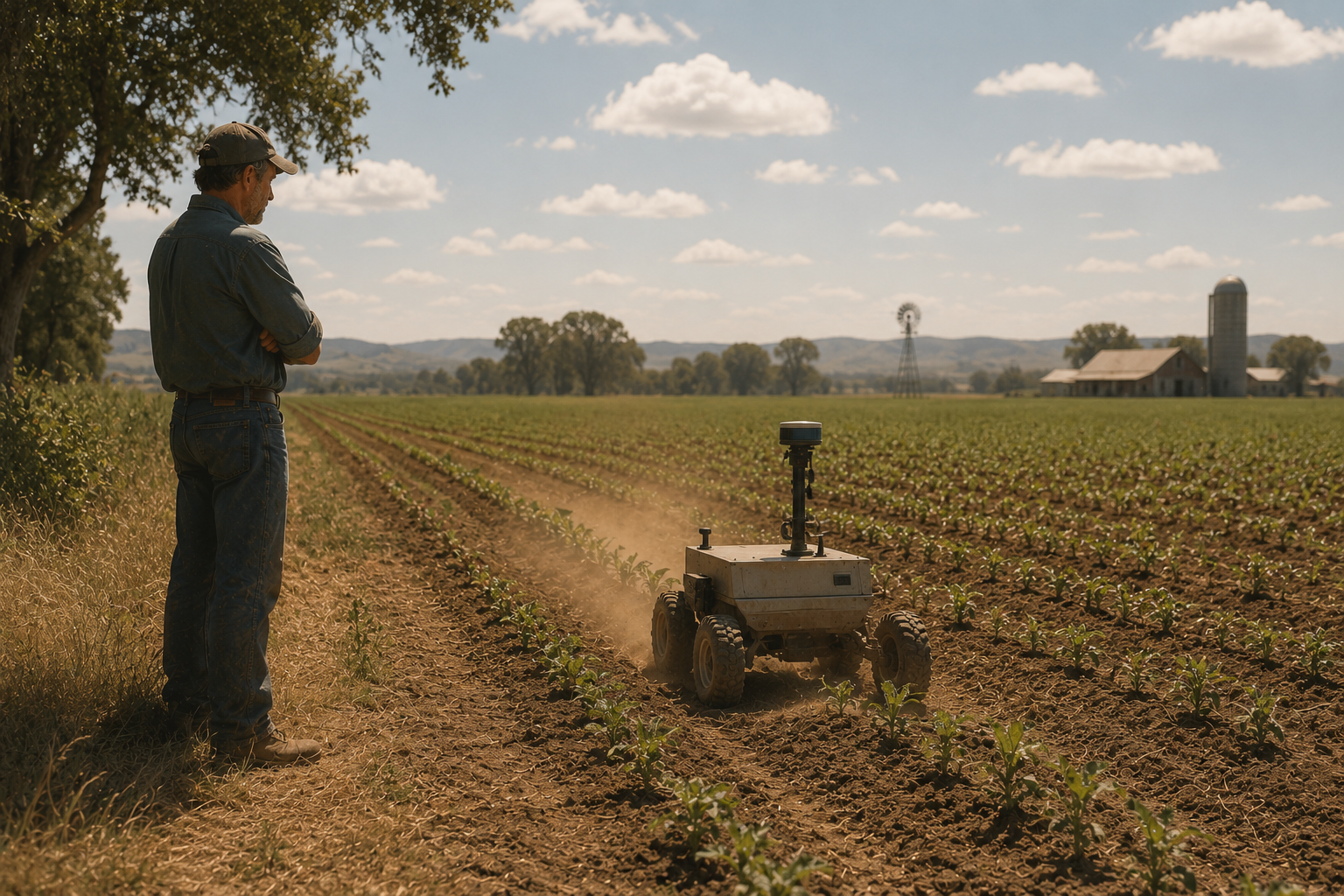
An affordable, open, low-compaction autonomous rover for small and mixed farms too small for commodity-scale equipment.
Published July 22, 2026·Last revised July 24, 2026
Mission Alignment
Small and mixed crop-and-animal farms can't use large-scale planting and tillage equipment — it's too big, too expensive, and compacts soil in a way that works directly against regenerative practice. This solution extends what a small farm's own labor can cover during narrow planting windows, without the compaction cost of heavier machinery.
Problem Statement
A Midwest corn farmer may have only five to seven days of optimal soil conditions at a time to plant thousands of acres. Small and mixed farms have no affordable, open, repairable autonomous platform sized for that reality — existing autonomous ag robots are priced for operations far larger than the ones this program targets.
Scope Boundary
In Scope
- Chassis, drivetrain, and power system
- Autonomy and navigation stack
- Weatherproofing and autonomous charging/docking behavior
- A defined mechanical, electrical, and data interface that lets implements attach and be swapped
Out of Scope
- The seeding mechanism and other implement internals — see the Seeding Implement solution
- The data platform itself, beyond consuming its field data for route and task planning
Product Components
Chassis & Drive
- Lightweight frame with independently driven wheels at each corner for tight-radius maneuvering
- Ground pressure engineered well below tractor-scale equipment to avoid soil compaction
Power
- Rechargeable battery pack sized for several hours of continuous field operation
Autonomy
- GPS-guided waypoint navigation with centimeter-level accuracy via a farm-fixed correction station
- Onboard obstacle sensing tuned for a mixed crop-and-livestock environment
- Autonomous return-to-charge behavior
Implement Interface
- A documented mechanical mount, power, and data-bus specification that lets third-party implements attach later
Phased Milestones
- Single drive-module prototype and bench integration of the drive and navigation stack
- Full chassis prototype, manually operated, with ground-pressure validation in real field and mud conditions
- Autonomy layer: GPS waypoint navigation, return-to-charge, and obstacle avoidance in a real field test
- Weatherized, farm-pilot-ready unit with the implement interface finalized
- First connection to field sensor data for informed route and task planning
Open Research Questions
- What tire and wheel choice best balances ground pressure, cost, and mud performance across the range of soil conditions target farms actually operate in?
- What obstacle-avoidance tuning is needed specifically for a mixed crop-and-livestock environment — slow-moving animals, irregular field boundaries — versus a row-crop-only assumption?
- What docking and charging approaches have other open-source agricultural robot projects used successfully, and what failure modes are documented?
Success Metrics
- Verified ground pressure low enough to avoid meaningful soil compaction, measured in the field, not just calculated
- Multiple hours of continuous autonomous operation on a single charge under real field conditions
- Reliable, repeated unattended return-to-charge cycles
Revision History
| Date | Changes |
|---|---|
| July 24, 2026 | First published |
Discussion