Part of the Accessible Essentials Initiative program
Farm Data Platform
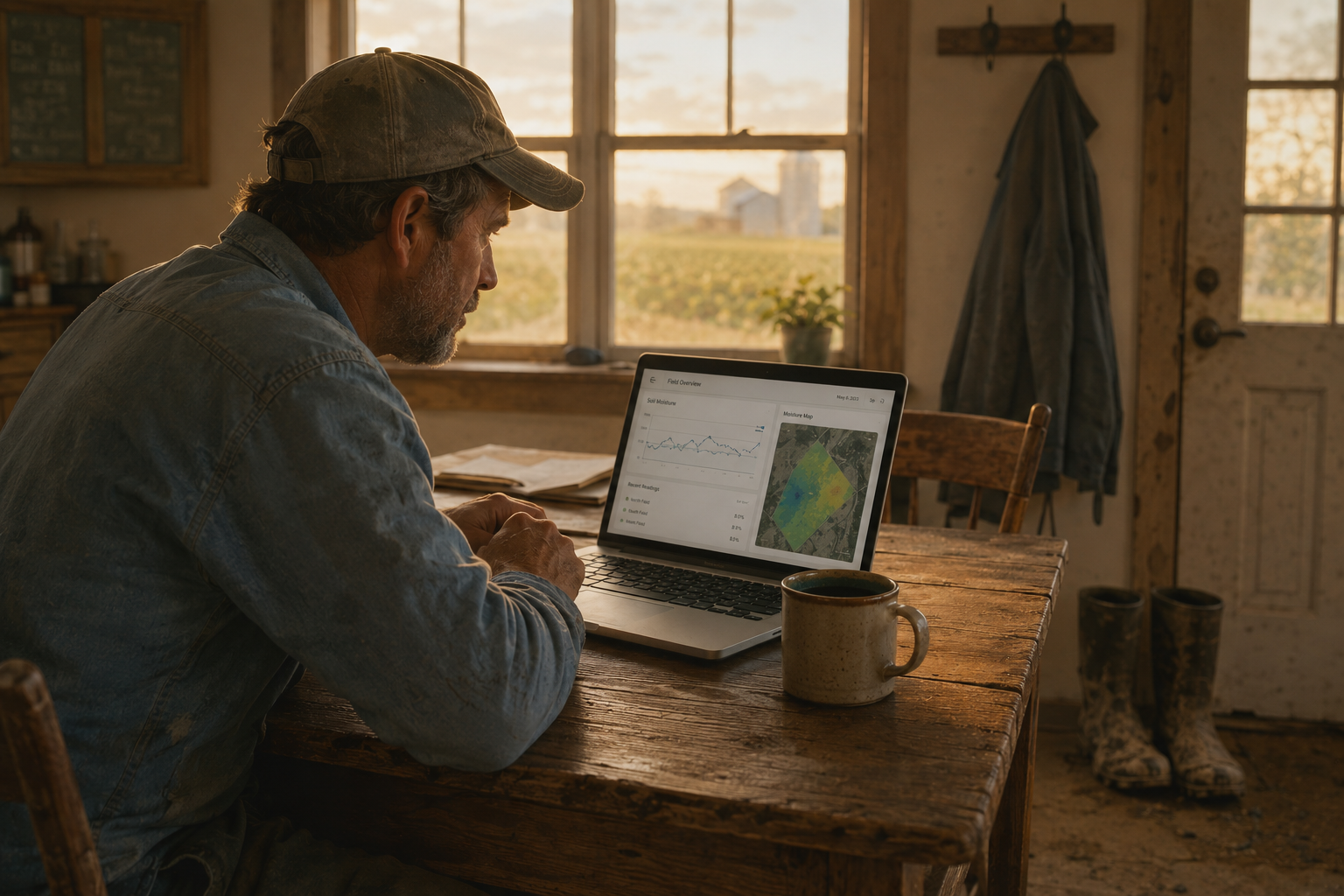
A farmer-owned dashboard, alerting, and eventual plain-language query layer that turns raw sensor readings into decisions, without a subscription trap.
Published July 22, 2026·Last revised July 24, 2026
Mission Alignment
Cost isn't actually the biggest barrier to small farms adopting precision agriculture — a University of Nebraska-Lincoln survey found 75% of farmers cite a lack of information about a technology's actual value as the top barrier, ahead of cost itself (56%). A separate survey of Southern cotton growers found that simple satisfaction with current practices was itself a common reason for not adopting precision technology. This solution's job is to turn raw sensor data into something a farmer can act on without a data science background or an IT department, closing the information gap rather than just the price gap.
Problem Statement
Enterprise farm management software is priced and designed for large operations and is closed and proprietary. Nothing affordable and open exists for small and regenerative farms that ties sensor data directly to grazing rotation, planting windows, and soil health trends.
Prior Research Findings
- 65% of surveyed farmers cite a lack of qualified labor or on-farm IT capacity as an adoption barrier, and 60% cite an overwhelming number of competing technology options (University of Nebraska-Lincoln CropWatch).
- Farmers have a documented history of being burned by agtech vendors that over-promise without delivering actionable insight — a trust gap that shapes how any new platform in this space needs to earn credibility (AgFunderNews).
Scope Boundary
In Scope
- Time-series ingest, storage, and preset dashboards
- Rule-based alerting and weather-API integration
- Historical, real-time, and forward-looking planning views
- A plain-language query layer, once enough real field data exists to make it trustworthy
- An open API so third-party sensors can feed the same platform
Out of Scope
- The physical sensors themselves — covered by the Field Sensor Network, Post-Harvest Storage Monitoring, and Water Monitoring solutions
- Direct control of physical devices beyond simple alert-triggered automations
Product Components
Ingest & Storage
- Time-series database built for irregular reporting intervals with built-in retention and downsampling
- A documented, versioned open ingestion API so any compatible sensor can push data into a farmer's account
Alerting & Decision Support
- Rule-based threshold alerts at launch, informed by public agronomic guidance
- Free public data sources — weather forecasts, soil survey data, and climate normals — integrated from day one
- A plain-language query layer sequenced for later, gated on having enough real field data to answer reliably
Data Ownership
- Full per-farm data export at any time, in open formats
- Cloud sync and any data-sharing are opt-in, never a default
Phased Milestones
- MVP: sensor ingest into a time-series store with basic dashboards, single-farm test
- V1: full custom dashboard, rule-based alert engine, weather integration, mobile-friendly views
- V2: plain-language query layer, once sufficient real field data exists to validate answer accuracy
- V3: open third-party sensor ingestion and the first data-cooperative integrations
Open Research Questions
- What text-to-query approach is most reliable for non-technical users asking natural-language questions about sparse, irregular farm sensor data, and how is hallucination risk bounded?
- What specific agronomic decision rules — planting-window thresholds, frost-risk models, rotational grazing recovery periods — are already publicly documented by extension services and land-grant universities, and can seed the alert engine without new agronomic research?
Success Metrics
- Dashboard and alert usefulness validated by real pilot farms using it unprompted, weekly
- A plain-language query layer only ships once answer-accuracy against known agronomic facts clears an explicit internal threshold, defined before building
Revision History
| Date | Changes |
|---|---|
| July 24, 2026 | First published |
Discussion