Part of the Accessible Essentials Initiative program
Water Monitoring
Irrigation-timing recommendations and water-quality sensing built on the same field sensor platform, because agriculture is roughly 70% of global freshwater use.
Published July 22, 2026·Last revised July 24, 2026
Mission Alignment
Agriculture accounts for roughly 70% of global freshwater use, and inefficient irrigation is both economically costly to farmers and environmentally destructive. Water sits alongside food and shelter as one of the physiological essentials this whole program is scoped around, and this solution is a natural extension of the same field sensor hardware already measuring soil moisture.
Problem Statement
Small farms mostly lack affordable tools to measure irrigation efficiency — are they over- or under-watering relative to actual crop and soil need — or to check water quality at wells, ponds, and irrigation sources.
Prior Research Findings
- Only about 12% of US farms currently schedule irrigation using an actual soil moisture measurement, rather than a fixed calendar or visual judgment (Oklahoma State University Extension).
- A midsouth US study across corn and soybean found threshold-based irrigation scheduling cut water application by up to 40% while maintaining or improving yield.
- A University of Georgia peanut irrigation study found real-time sensor scheduling increased yield roughly 20% while cutting water use up to 60%.
Scope Boundary
In Scope
- Irrigation-timing recommendations built on the soil moisture data the field sensor platform already collects
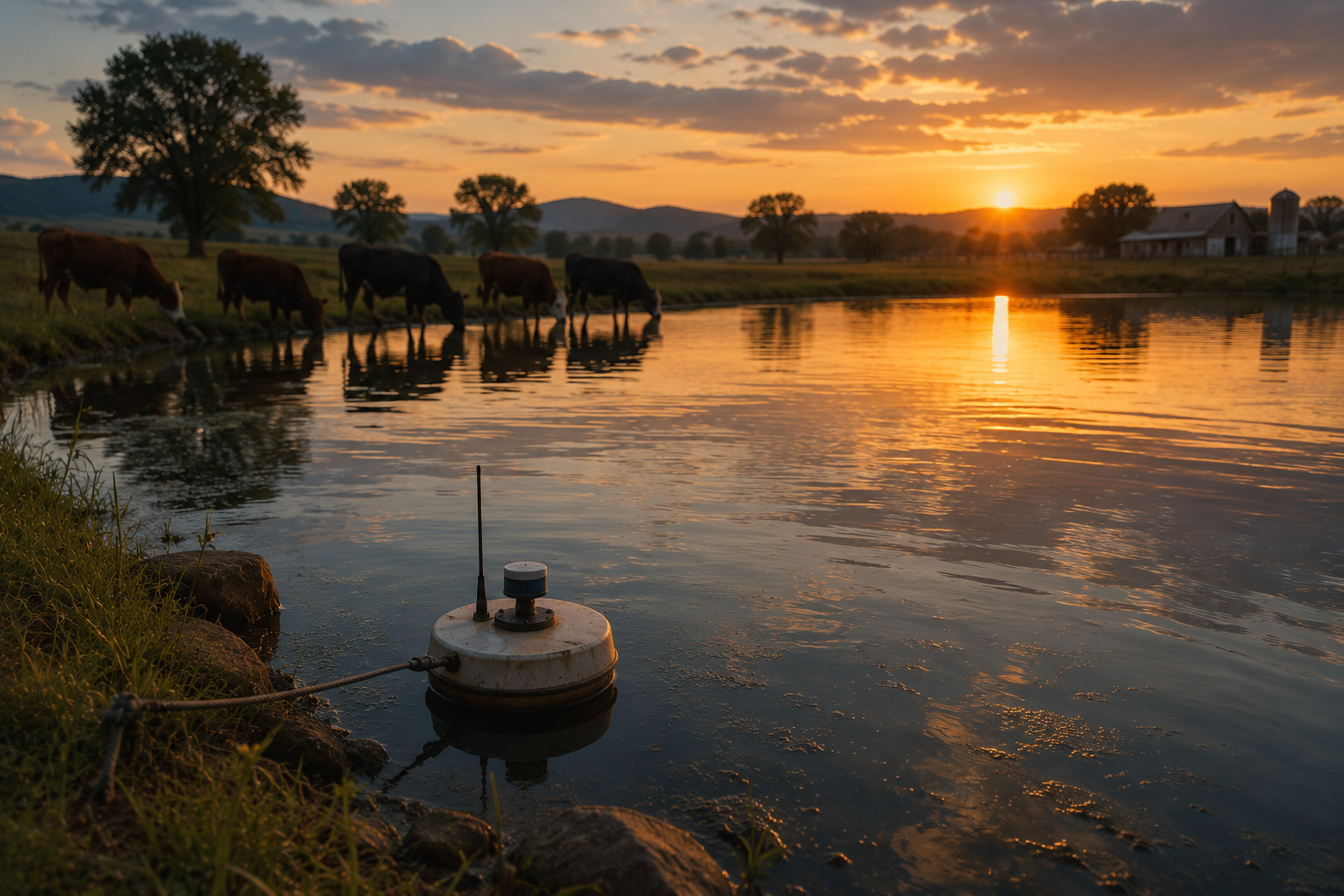
- A new water-quality sensor variant — pH, conductivity, and turbidity — for wells, ponds, and irrigation source points
- Rainfall-informed irrigation adjustment
Out of Scope
- Irrigation actuation hardware such as valves and pumps — a future integration once the monitoring and recommendation layer is proven, not a first-version build item
- The core soil moisture sensing hardware itself, which is the Field Sensor Network solution
Product Components
Irrigation Recommendation Logic
- Combines existing soil moisture readings with an evapotranspiration estimate from public weather-forecast data
- Runs as a data-platform feature — no new field hardware required for this piece
Water Quality Node
- Submersible or inline pH, conductivity, and turbidity sensing
- Deployed at well heads, ponds, or irrigation source points
- Feeds trend dashboards and threshold alerts — for example, contamination risk after heavy-rain runoff
Phased Milestones
- Build irrigation-timing recommendation logic using existing soil moisture data and public weather-forecast data — software only, no new hardware for this piece
- Prototype a water-quality sensor node in a submersible or inline enclosure
- Pilot at a farm with an active irrigation system or livestock water source, validating recommendation accuracy against the farmer's own judgment
- Evaluate whether valve or pump actuation is warranted based on pilot farmer demand
Open Research Questions
- What evapotranspiration calculation method is realistic to run on data available from free weather APIs, without expensive dedicated weather station hardware?
- What water quality thresholds matter most for small mixed farms specifically — livestock drinking water safety, irrigation source suitability, or runoff contamination — and which should be prioritized first?
Success Metrics
- Irrigation recommendations demonstrably reduce water use or improve timing accuracy versus a farmer's prior practice in at least one pilot season
- The water-quality node survives a full season of submersible or inline deployment without fouling-induced failure
Revision History
| Date | Changes |
|---|---|
| July 24, 2026 | First published |
Discussion