Part of the Accessible Essentials Initiative program
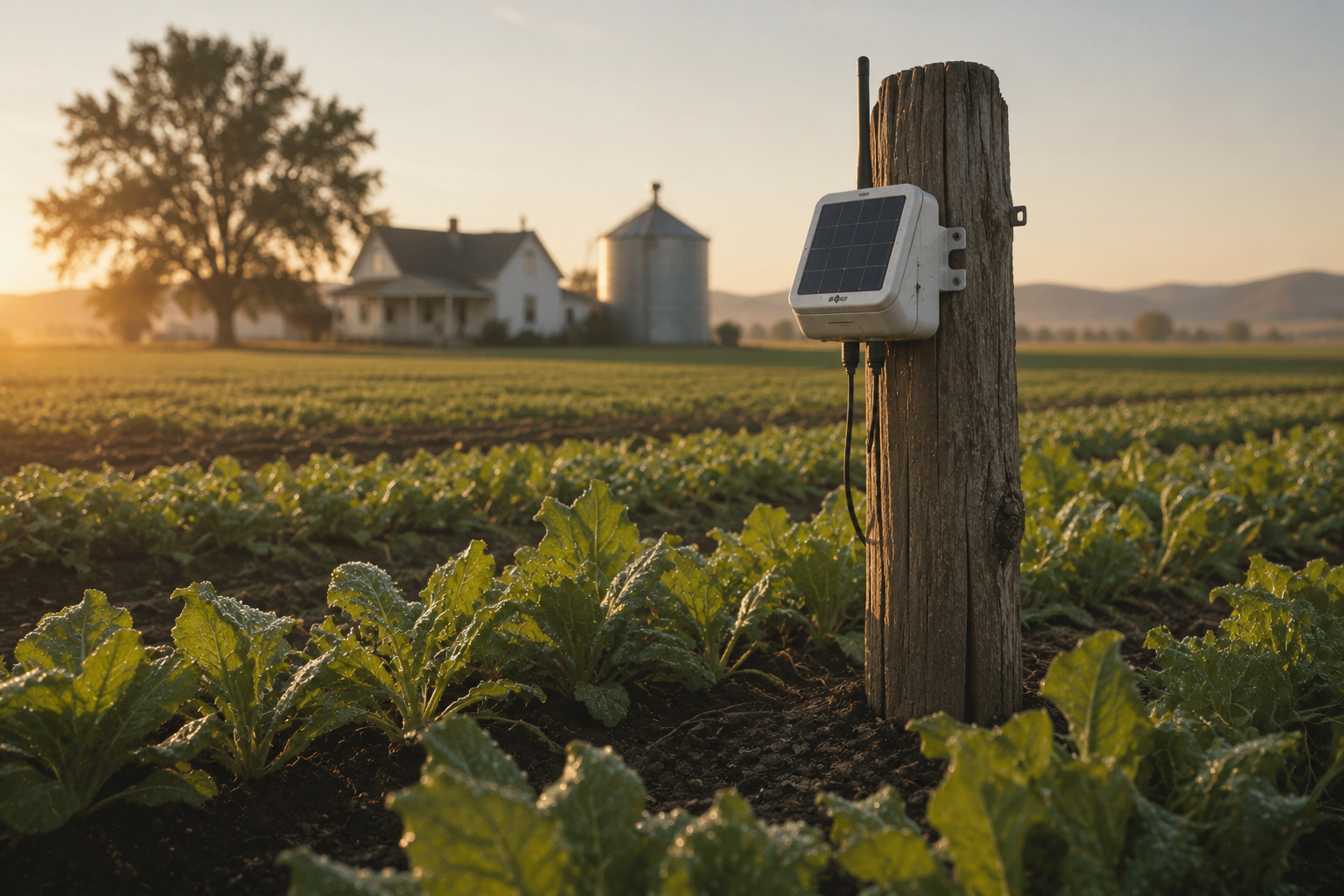
Field Sensor Network
Affordable, farmer-owned soil and weather monitoring for small and regenerative farms priced out of enterprise precision agriculture.
Published July 22, 2026·Last revised July 24, 2026
Mission Alignment
Only 27% of US farms use any precision agriculture technology at all, and adoption concentrates almost entirely in large operations — the sensor platforms built for precision agriculture are priced and designed for that scale, out of reach for most small and mid-size operations. This solution puts calibrated, networked environmental and soil sensing within reach of the farms most structurally locked out of it today, prioritizing small and regenerative operations that existing agtech doesn't price for.
Problem Statement
Small and mid-size farms — especially regenerative and mixed operations — lack affordable, calibrated, networked monitoring of soil moisture, soil and air temperature, humidity, and rainfall. Without it, most irrigation and planting decisions are still made on fixed calendar schedules or visual judgment rather than measurement, and the data that would justify the switch is priced out of reach.
Prior Research Findings
- Only about 12% of US farms currently schedule irrigation using an actual soil moisture measurement; most build in a wide safety margin against under-watering by watering on a fixed schedule instead (Oklahoma State University Extension).
- In multi-county field trials, soil moisture sensor-based irrigation scheduling increased net farm income by an average of 19.42%, ranging $87–$641 per acre (Clemson University / USDA-NRCS).
- A University of Georgia peanut irrigation study found real-time sensor scheduling increased yield roughly 20% while cutting water use up to 60%.
- Roughly 96% of nitrogen loss under over-irrigated conditions occurs via leaching below the root zone — meaning over-watering also wastes fertilizer that's already been paid for, not just water (peer-reviewed study, PMC/NCBI).
Scope Boundary
In Scope
- Static in-field sensor nodes measuring soil moisture at two depths, soil temperature, air temperature and humidity, and rainfall
- A farm gateway that collects readings from field nodes and bridges them to the cloud data platform
- Documented, farmer-repeatable calibration procedures
- Solar and battery power design built for 6–18 months of unattended operation
Out of Scope
- Dashboards, alerts, and the natural-language query layer (a separate solution: the Farm Data Platform)
- Any wearable or livestock-worn sensing
- Actuated or moving hardware such as irrigation valves or gates
Product Components
Field Sensor Node
- Low-power microcontroller with radio for mesh networking back to the farm gateway
- Dual-depth capacitive soil moisture, soil temperature, air temperature/humidity, barometric pressure, light, and tipping-bucket rainfall sensing
- Solar panel plus rechargeable battery sized for 6–18 months of autonomy at a 15-minute reporting interval
- Weatherproof enclosure rated for full outdoor exposure — heat, cold, dust, mud, and direct sun
Farm Gateway
- Collects readings from field nodes over a self-healing mesh network and bridges them to the cloud
- Local storage buffers data during connectivity outages
- Doubles as a mounting point for additional point sensors at the gateway location itself
Phased Milestones
- Bench prototype: single sensor node and gateway on wired power, validated against reference instruments
- Field prototype: solar and battery autonomy test, full outdoor durability validation, first real farm deployment
- Production revision: custom carrier hardware, a repeatable calibration jig, and enclosure tooling for low-volume production
- Multi-farm pilot with a spare-parts catalog for field-replaceable wear components
Open Research Questions
- What is the real accuracy and drift profile of low-cost capacitive soil moisture sensors over a full growing season in clay versus sandy soils, and what calibration routine corrects for it cheaply?
- What is the actual outdoor lifespan of commodity solar panels and batteries under full summer sun and freeze-thaw cycling, and which battery chemistry holds up best at this scale?
- What incremental sensors — soil salinity, a nutrient proxy, leaf wetness — are worth adding without breaking the target price point?
Success Metrics
- Better than 90% node uptime over a full growing season in field pilots
- Calibration drift within agronomically useful tolerance without lab recalibration
- Hardware priced to be genuinely accessible to the small and mid-size farms current precision-ag options price out
Revision History
| Date | Changes |
|---|---|
| July 24, 2026 | First published |
Discussion